Forum “A Shared Future: Moldova and the Global Agenda for Democracy,” June 19, Chișinău
The event will be facilitated by the AI-Viziune Academy, a nonpartisan civic think tank that aims to foster broad-based political dialogue with key target groups on the vision for European integration and tools for democratic resilience. In Chișinău, the one-day forum “A Shared Future: Moldova and the Global Agenda for Democracy” advances a clear European proposition: democratic resilience is not merely a domestic agenda—it is a pillar of continental security. Building on the idea that EU enlargement can serve as a stabilizing security anchor, the event brings together national institutions, European partners, experts, and opinion leaders to translate recent lessons—such as hybrid pressure, energy vulnerabilities, and information threats—into practical and actionable responses.
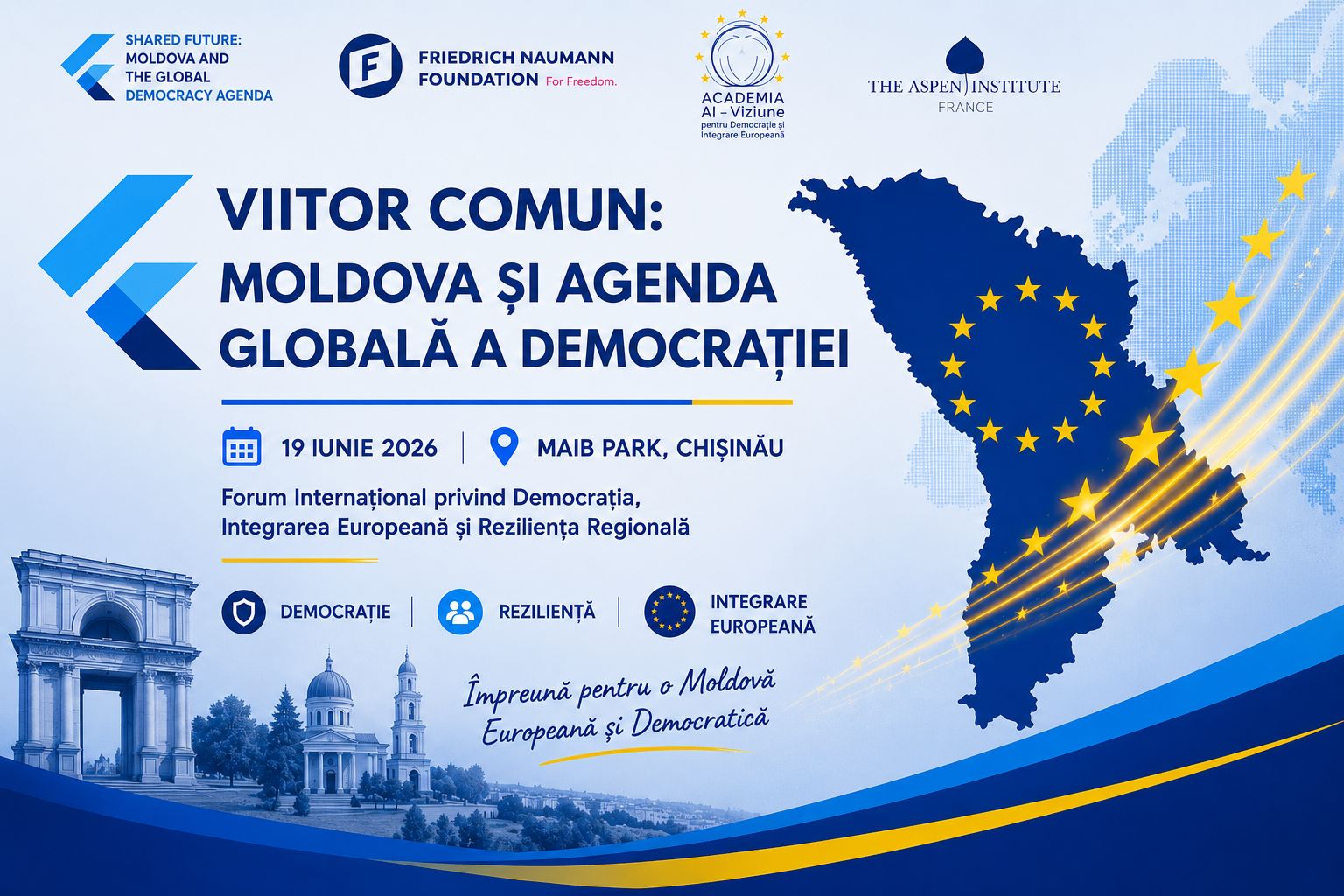
Forum “A Shared Future: Moldova and the Global Democracy Agenda,” June 19, Chișinău
ABOUT THE EVENT
The event will be facilitated by the AI-Viziune Academy, a nonpartisan civic think tank that aims to foster broad-based political dialogue with key target groups on the vision for European integration and tools for democratic resilience.
In Chișinău, the one-day forum “A Shared Future: Moldova and the Global Agenda for Democracy” advances a clear European proposition: democratic resilience is not merely a domestic agenda—it is a pillar of continental security. Building on the idea that EU enlargement can serve as a stabilizing security anchor, the event brings together national institutions, European partners, experts, and opinion leaders to translate recent lessons—such as hybrid pressure, energy vulnerabilities, and information threats—into practical and actionable responses.
The program follows a deliberate structure: an official opening, a strategic discussion on the implementation of the European Democracy Shield, followed by debates on the challenges of EU integration and the lessons learned by EU member states in this process, discussions on the opportunities that EU integration could bring to the Romania-Republic of Moldova-Ukraine region, and, last but not least, a discussion on how to maintain independent journalism in these difficult times. The event will draft and adopt a Forum Declaration that will highlight Moldova’s contribution to the European agenda on democratic resilience.
As the organizer, the AI-Viziune Academy positions the Forum within a “future-oriented vision” that connects institutions, society, and European partners through evidence-based policies, strategic communication, and responsible digital tools. The expected outcome is a Declaration containing a set of recommendations that strengthen Moldova’s European trajectory through a functional democracy and demonstrated resilience.
It is proposed that the event be opened by a Keynote Speaker on democracy in European Union countries.
The first panel addresses the Forum’s central question: how can Moldova, as a candidate country on the front lines of hybrid threats, contribute in practical terms to the “European Shield of Democracy”? The discussion will cover institutional capacity (electoral integrity, transparent decision-making, strategic communication) alongside societal resilience—public trust, civic education, and structured partnerships with civil society.
The second panel highlights the experience of Central and Eastern European countries that have completed their transition to EU membership—often learning that integration means not only legal harmonization but also building a democracy resilient to polarization, institutional capture, and information manipulation. The discussion will draw transferable lessons for Moldova: prioritizing reforms, strengthening public administration, communicating reforms, the role of civil society and the media, and how European standards can protect pluralism.
The third panel translates resilience from an abstract principle into infrastructure and interdependence: economic growth, connectivity, energy, and security as practical prerequisites for freedom and stability. In the Romania–Moldova–Ukraine triangle, the question is not just “how to withstand,” but “how to build together” chains of resilience: energy interconnections, logistics corridors, cooperation in cybersecurity, protection of critical infrastructure, and regulatory compatibility. The discussion will focus on the synergies between reforms and investments, the EU’s role as a facilitator, and how regional resilience can accelerate Moldova’s European integration.
If democratic resilience has a daily front line, it is the information space. This final, fourth panel examines the role of independent journalism as a pillar of genuine democracy in upholding standards of truth, public accountability, and social cohesion amid hybrid warfare, financial pressure on newsrooms, and the rapid adoption of digital tools (including AI). The discussion will address uncomfortable questions: how to protect editorial independence, increase transparency in the online ecosystem, prevent technology from amplifying manipulation, and expand media literacy.
The key messages to be discussed at the event will be as follows:
- EU enlargement strengthens European security through resilient democracies and credible institutions.
- Moldova can contribute to the European Democracy Shield through reforms, cooperation, and information resilience.
- Romania–Moldova–Ukraine can deliver: connectivity, energy, security, and a protected information space.
The main position formulated during the Forum’s debates will be included in the Final Declaration. The Forum’s Declaration should set out, in clear and measurable terms, Moldova’s commitment to act as a partner for Europe’s democratic security: accelerating reforms that strengthen the rule of law and public trust; advancing regional cooperation between Romania, Moldova, and Ukraine in the fields of energy, connectivity, cyber resilience, and critical infrastructure; and protecting the information space by supporting independent journalism, media literacy, and responsible digital tools. The declaration may also call on European partners to support these objectives through expertise, institutional capacity-building programs, and cooperation mechanisms—within a civic, nonpartisan, results-oriented framework, in line with the AI-Vision for Democracy and European Integration mission.
The benefits of participating in the Forum are as follows:
- Understand how the European Democracy Shield translates into practical reforms, capacity-building, and cooperation for Moldova.
- Learn transferable lessons from CEE member states that have already completed their accession processes.
- Help shape a regional RO–MD–UA agenda in which energy, connectivity, and security support democratic resilience.
- Gain practical insights for protecting the information space and supporting independent journalism amid hybrid warfare and digital disruptions.
The Forum is expected to bring together at least 150 participants, of whom at least 15 will be invited from European Union countries, representing MEPs, members of the parliaments of EU countries and the Republic of Moldova, the European Commission, and European and Moldovan think tanks.
EVENT PROGRAM (see the website https://event.aiviziune.md/ )
With the support of:

An event organized by the Friedrich Naumann Foundation for Freedom (FNF). Supported by FNF. Co-funded by FNF.
The Friedrich Naumann Foundation for Freedom is not responsible for the content of the program or for any use that may be made of it. The opinions expressed here belong exclusively to the speaker(s). These opinions do not necessarily reflect those of the Friedrich Naumann Foundation for Freedom.